W–018 · Documentary photograph and sources
The Elephant’s Foot
To obtain a piece of the Elephant’s Foot for study in 1987, researchers had to shoot at the hardened mass. It had formed beneath the destroyed fourth unit of the Chernobyl nuclear power plant after the accident of 26 April 1986. Molten fuel mixed with concrete, sand and structural metal, flowed into rooms below and solidified. Through service penetrations, the melt moved from corridor 301/6 into room 217/2. One deposit became known as the Elephant’s Foot; others were called the “stalactite” and the “drop.”
1. Korneyev beside the Elephant’s Foot
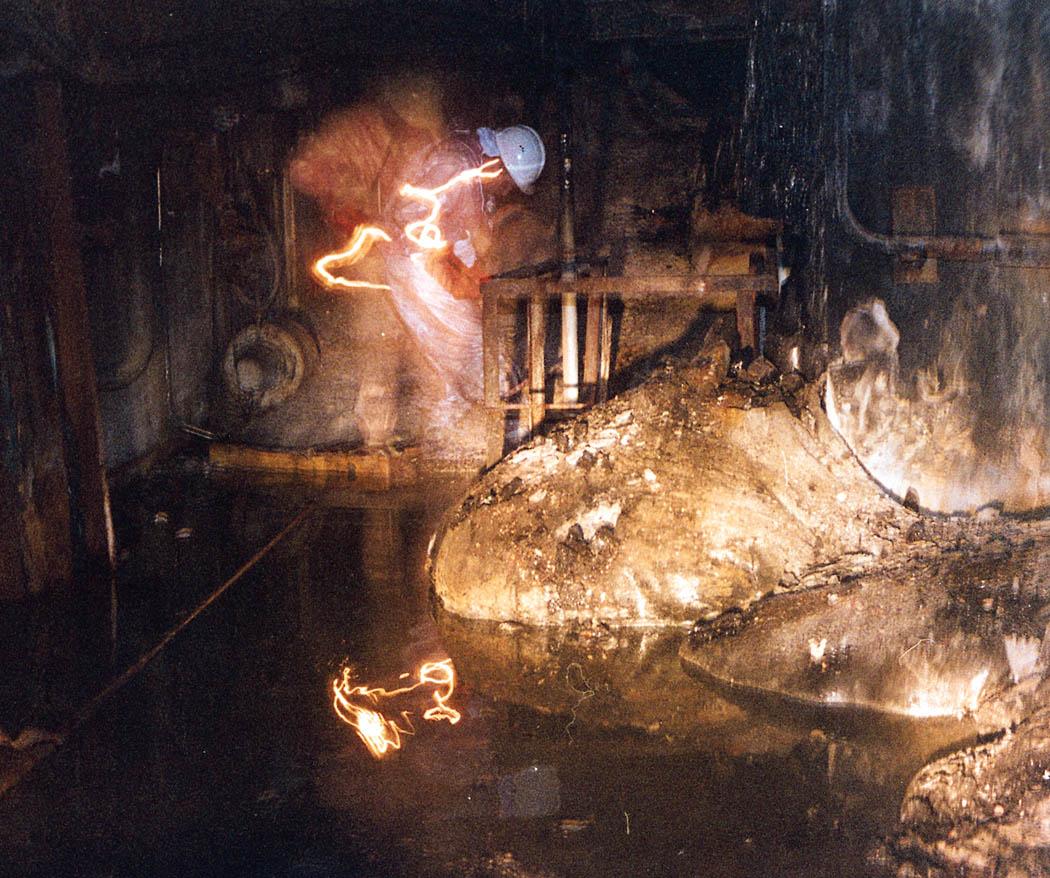
Provenance and sources for frame 1
Displayed file: 1050 × 878 pixels. Full image record in Russian.
flickr.comatlasobscura.comibrae.ac.ruibrae.ac.ruView image fileThe mixture is often called corium. Chernobyl researchers use the more specific term lava-like fuel-containing materials, or LFCM. At first the mass was black, glassy and very hard. It consisted chiefly of silica, with other constituents including uranium compounds. Samples emitted radiation with the same spectrum as irradiated reactor fuel. The Nuclear Safety Institute of the Russian Academy of Sciences estimates that all the LFCM in room 217/2 contains 0.4 ± 0.2 tonnes of uranium. That is the uranium in all the deposits in the room, not the weight of one Elephant’s Foot.
According to the institute, the radiation field at the surface exceeded 800 roentgens per hour. Early samples were collected remotely. Five years after the researchers had fired at it to obtain fragments, an adhesive-coated gauze swab was enough: pieces several centimetres across stuck to it and broke away. The once-hard mass had begun to crumble.
2. A visitor in protective clothing
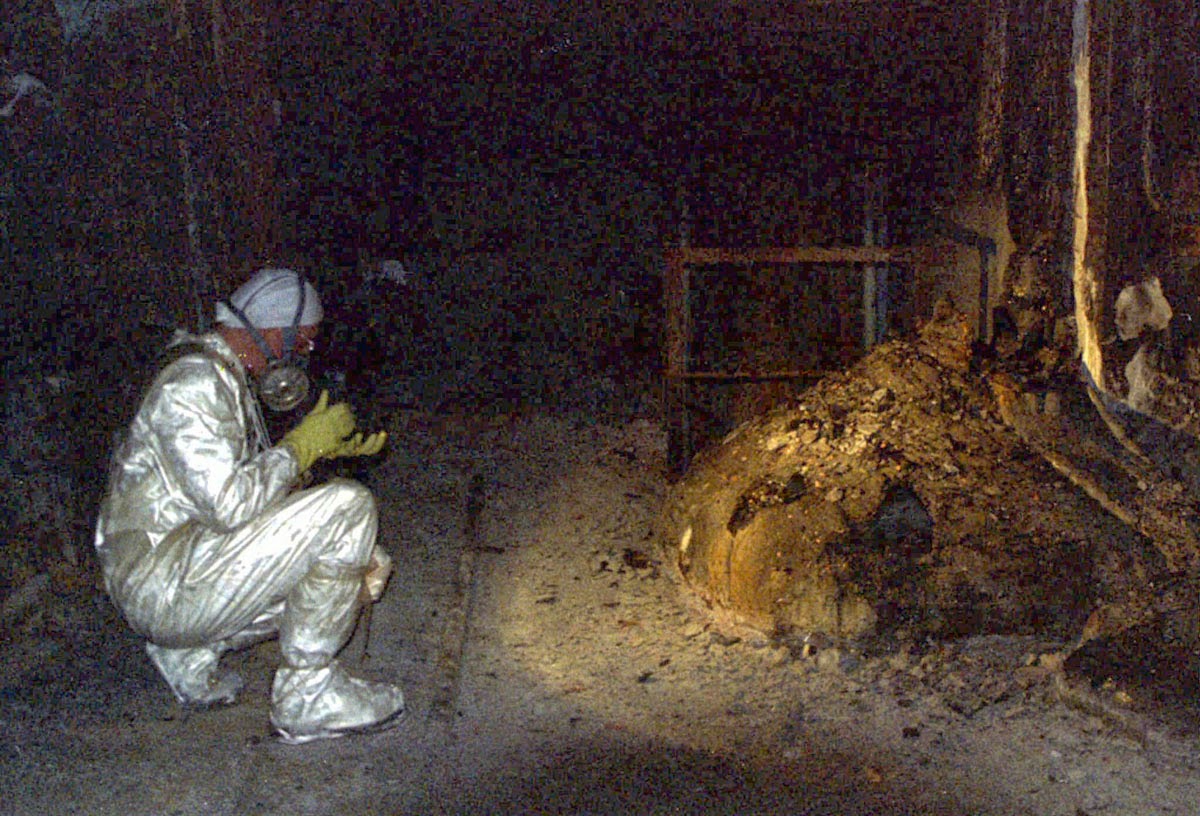
Provenance and sources for frame 2
Displayed file: 1200 × 816 pixels. Full image record in Russian.
gettyimages.com.auscientificamerican.com22century.ruView image fileAbout ten years after the accident, researchers confirmed that some of the material was turning into fine radioactive particles. A review by the Japan Atomic Energy Agency considers changes in temperature, air movement and the material’s own radiation. Its authors judge their contribution to the physical breakdown to be relatively small.
3. Solidified flow in room 217/2

Provenance and sources for frame 3
Displayed file: 1050 × 865 pixels. Full image record in Russian.
flickr.comView image fileMoisture appears to matter more to the chemical changes: irradiation makes it more chemically reactive. Uranium-bearing deposits have been found on the surface. Researchers also discuss the possible role of microorganisms, although the detailed mechanism of biological ageing remains unknown.
4. Black-and-white archival view

Provenance and sources for frame 4
Displayed file: 960 × 630 pixels. Full image record in Russian.
flickr.comView image fileIn autumn 1996, Arthur Korneyev, deputy director of the Shelter facility, was photographed beside the Elephant’s Foot. His outline is blurred; his torch has left a streak of light. Atlas Obscura later suggested that he set a camera on a timer and stepped into the frame, and the picture became known as a “selfie.” The archive, however, does not say who positioned the camera or pressed the shutter. Korneyev is credited with another photograph of the Elephant’s Foot from the same autumn; the image showing him has no established author.
Some photographs in this collection have no known date, so they cannot be arranged as a strict visual history of the Elephant’s Foot’s deterioration. Even the picture in the “current condition” section of Chernobyl’s official Shelter site has no shooting date. PastVu dates it to 12 August 2000 and tentatively attributes it to Alexander Kupny, citing a later VKontakte post. No primary source confirms that dating. Nor is there evidence that it shows the Elephant’s Foot as it looks today.
5. The cracking surface
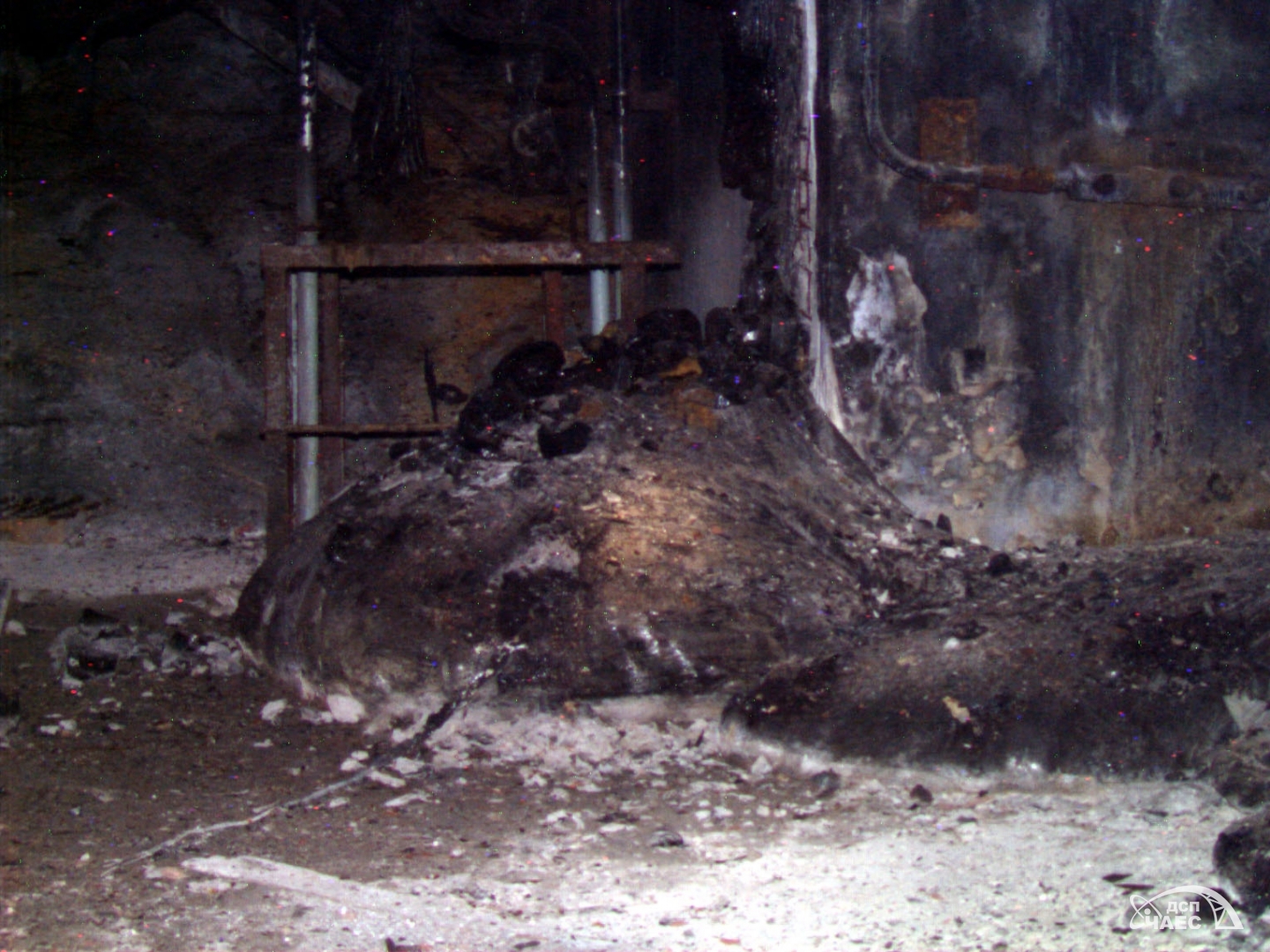
Provenance and sources for frame 5
Displayed file: 1440 × 1080 pixels. Full image record in Russian.
chnpp.gov.uapastvu.comView image file