W–051 · Photograph date unknown · Photograph location unknown
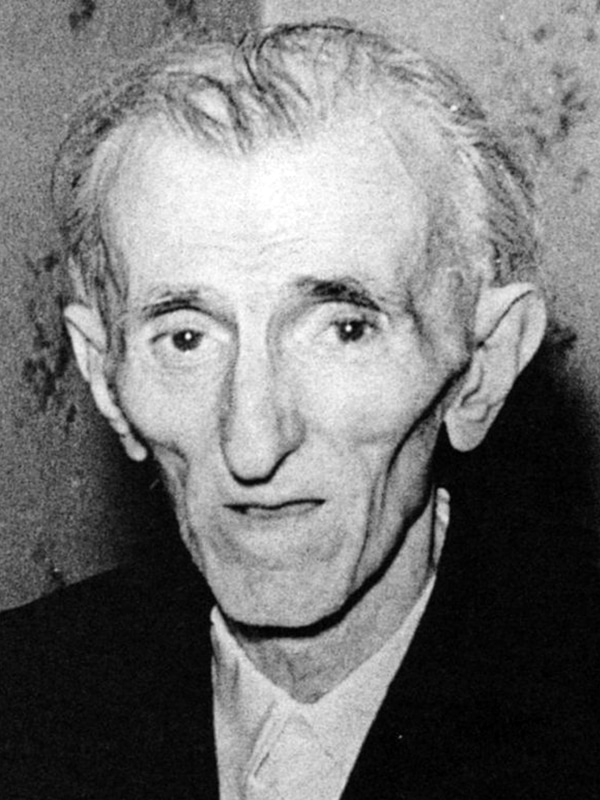
Tesla's Late Portrait
Nikola Tesla spent the last ten years of his life living and working at the New Yorker Hotel. He could no longer afford a laboratory but continued his experiments at the hotel. His Wardenclyffe tower on Long Island, intended as the first station in a worldwide network for wireless communication and power transmission, had been demolished for scrap to pay his debts in 1917. The project remained unfinished.
1. Late portrait
Provenance and sources for frame 1
File and rights
Public black-and-white copy, 600 × 800 pixels. Archival original and rights holder unidentified; no free licence stated. This is not verified as the “last photograph” or as an exposure of 1 January 1943.
His earlier work had changed the electrical grid. Tesla developed a polyphase alternating-current system and an induction motor, receiving US patents for its basic elements in 1888. His work helped shape the systems still used to generate, transmit and use electricity. He later studied high-frequency currents and tried to build a station at Wardenclyffe to send power and messages without wires.
By the early 1940s, Tesla no longer had his old laboratory and had limited means. A photo album issued by the University Library of Niš captions this late portrait as “probably the last photograph”, without naming a date or photographer. Online captions date it to 1 January 1943. That date has not been verified. The Nikola Tesla Museum says the last photograph Tesla kept was taken in 1942, without explicitly identifying it as this portrait. Its exposure date and status as the final lifetime image remain open.
Tesla died at the New Yorker Hotel on 7 January 1943. The museum gives coronary thrombosis as the cause of death. After his death, his papers and property were sealed and transferred to the US Office of Alien Property Custodian; his nephew Sava Kosanović became his heir. At Kosanović’s initiative, the estate was shipped to Yugoslavia in 1951. The Nikola Tesla Museum was founded there in 1952 and now holds Tesla’s manuscripts, devices and photographs. His ashes were brought to Belgrade in 1957 and are kept in the museum.