W–021 · Documentary photograph and sources
The Vulture and the Child
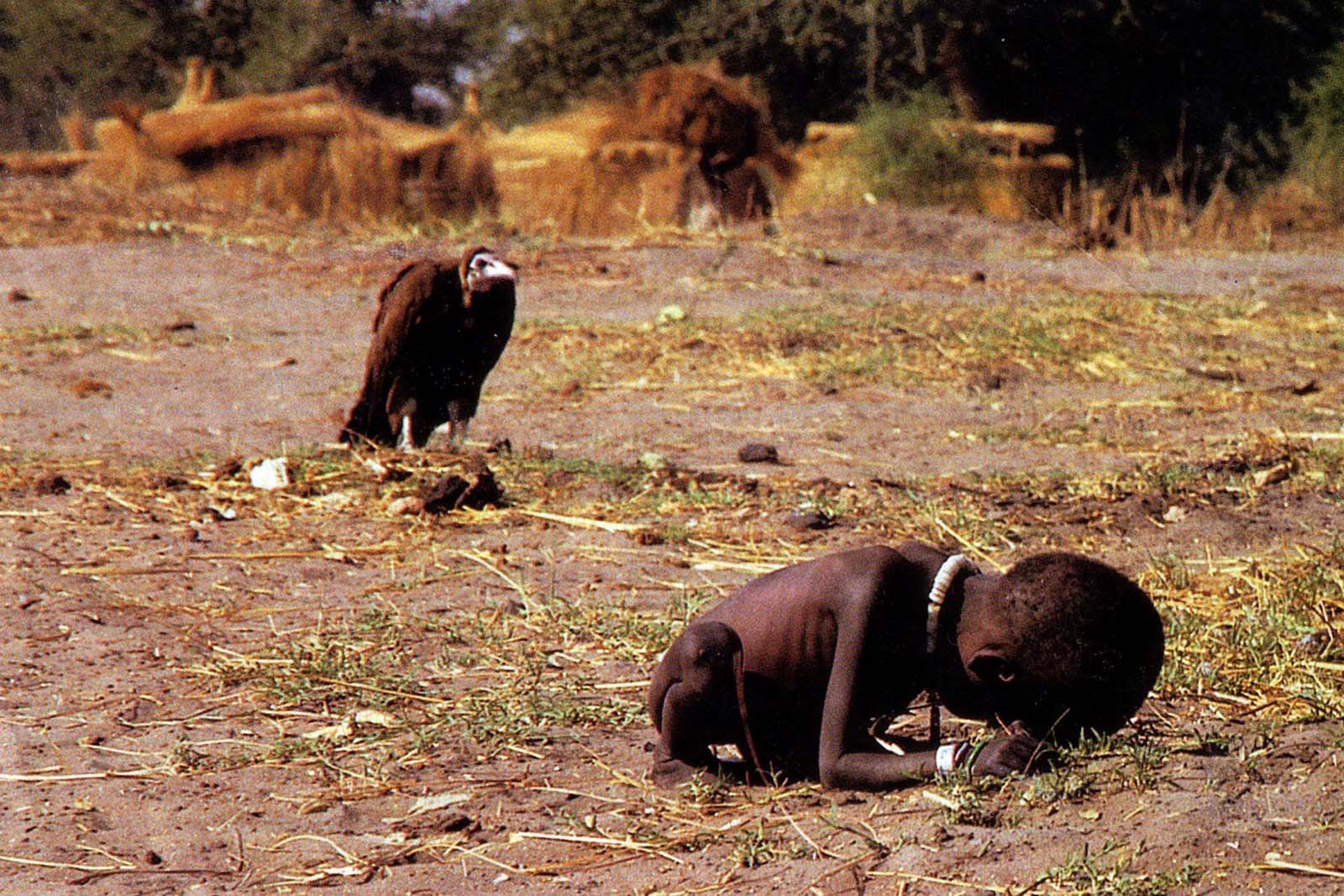
What happened to the child? Readers of The New York Times called and wrote to the paper after its 26 March 1993 edition. It had printed Kevin Carter’s photograph of an emaciated child on the ground, a vulture behind. Carter had brought the image from Ayod in what was then southern Sudan, where he had been documenting famine with photojournalist João Silva and staff of Operation Lifeline Sudan.
1. The child and the vulture
Provenance and sources for frame 1
Kevin Carter made the photograph near Ayod, Sudan, in March 1993. The New York Times first published it on 26 March. Getty Images lists Kevin Carter / Sygma, ID 587828802, and copyright protection. The displayed file is a later editorial copy; the original negative was not found in an open archive. Displayed file: 1600 × 1067 pixels. The source identifies this image as copyrighted. Full image record in Russian.
gettyimages.com.aupulitzer.orgcontent.time.comelmundo.esView image fileThe caption called the child a girl who had collapsed on the way to a feeding centre. Four days later, the paper explained, on Carter’s account, that he had chased off the bird and the child had moved on. The newspaper did not know whether the child reached the centre. The photograph travelled the world; the answer readers sought remained incomplete.
Carter was awarded a Pulitzer Prize in April 1994 and travelled to New York to receive it in May. Recognition came with reproach: why had he photographed the child rather than taking her to safety? A newspaper compared him to a second vulture. TIME reported that his friends, too, asked what he had done.
On 27 July 1994, Carter died by suicide. He was thirty-three. Afterwards, some said public attacks over the Sudan photograph had driven him to it. TIME journalist Scott MacLeod, who reconstructed Carter’s final months, also described depression, financial trouble and setbacks at work. In April, Carter’s close friend Ken Oosterbroek had been killed on assignment.
In his suicide note, Carter listed what he could not afford: housing, child support and debts. He also wrote that he was haunted by vivid memories of killings, corpses, anger and pain. The accusations surrounding the photograph formed part of his final months. Neither the note nor the accounts gathered by MacLeod support treating them as the sole cause of his death.
In 2011, El Mundo correspondent Alberto Rojas travelled to Ayod, now in South Sudan. He reported that a family recognised the child by a feeding-centre bracelet: a boy named Kong Nyong. His father said Kong had survived the famine, grown up and died of fever in 2007. This later account rests on the family’s statements as reported by El Mundo. The original newspaper caption had not even supplied a name.