W–042 · Documentary photograph and sources
The Buses After the Assault
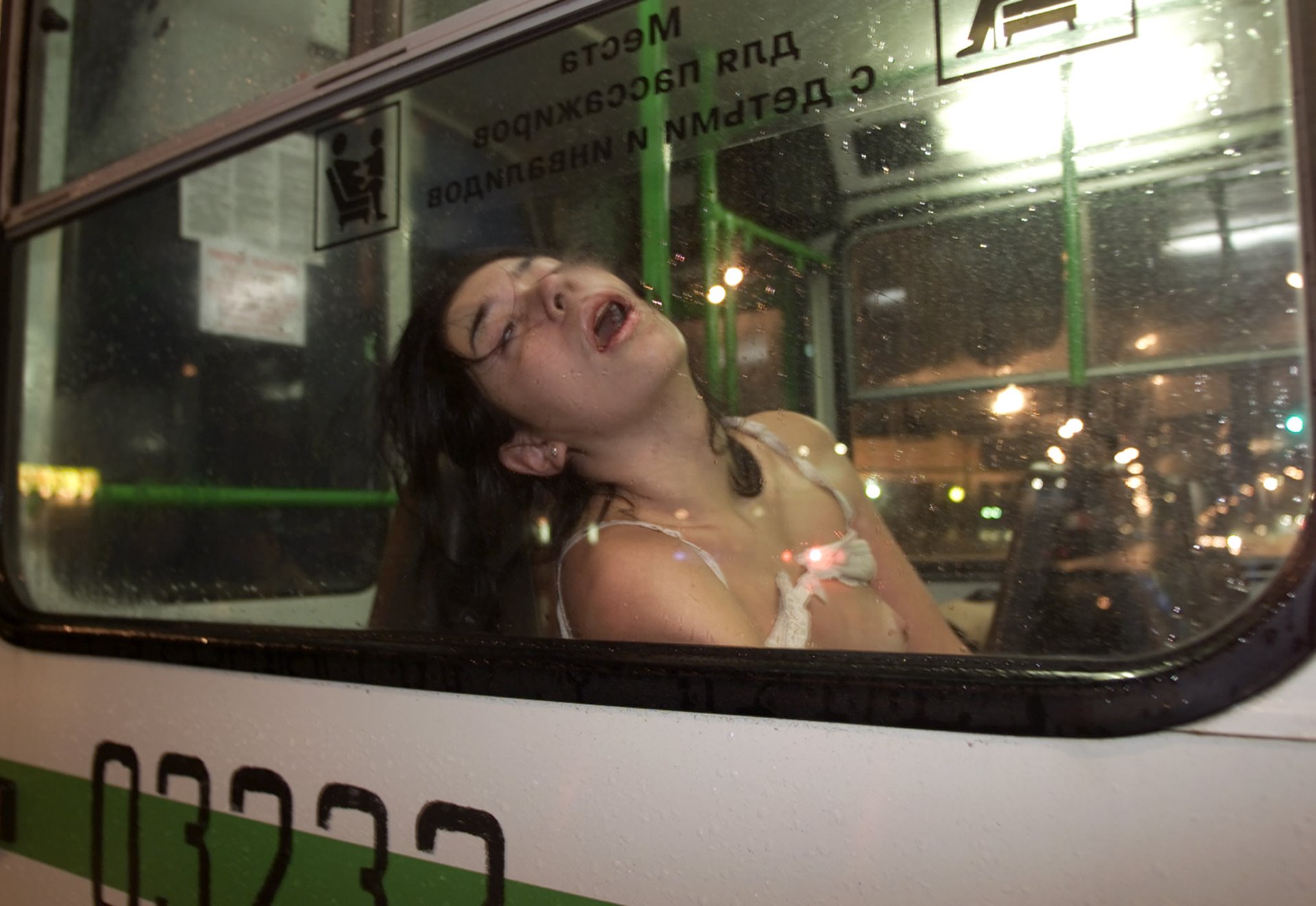
“We do not know whether she survived,” Tom Parfitt wrote a year after the assault on the Dubrovka theatre. The Sunday Telegraph’s Moscow correspondent was trying to find the woman taken from the theatre in a bus on the morning of 26 October 2002. Justin Sutcliffe’s photograph of her had already won a World Press Photo award. The journalists now asked Russian readers to help learn what had happened to her. No reliable account of her later fate has emerged from the sources examined here.
1. The woman at the window
Provenance and sources for frame 1
Justin Sutcliffe / The Sunday Telegraph / Image Sans Frontière, 26 October 2002. World Press Photo awarded this photograph third prize in Spot News Singles in 2003. Its record does not identify the woman or establish what happened to her. The relative order of the four photographs is unknown. Displayed file: 1920 × 1322 pixels. No free licence has been established for this file. Full image record in Russian.
worldpressphoto.orgView image fileOn the evening of 23 October, an armed group led by Movsar Barayev seized Moscow’s Dubrovka Theatre Centre during a performance of the musical Nord-Ost. The hostages included audience members, performers and theatre staff. The captors demanded the withdrawal of Russian troops from Chechnya. The captors wired the building with explosives. Female members of the armed group carrying explosive devices were positioned among the hostages. Negotiations continued for more than two days. Some people were released, but hundreds remained inside until the morning of 26 October.
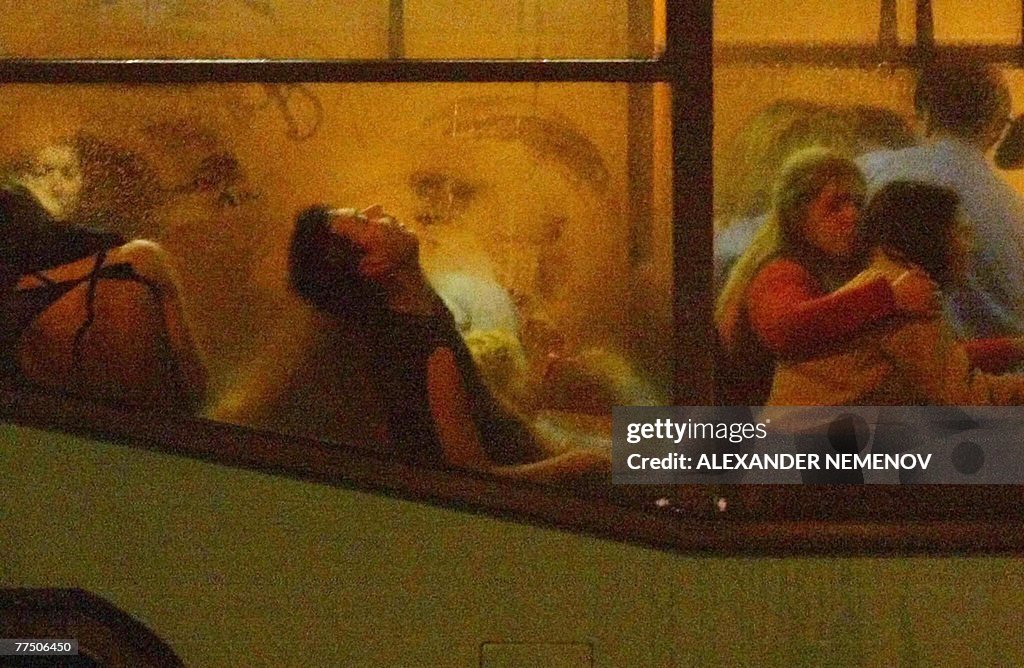
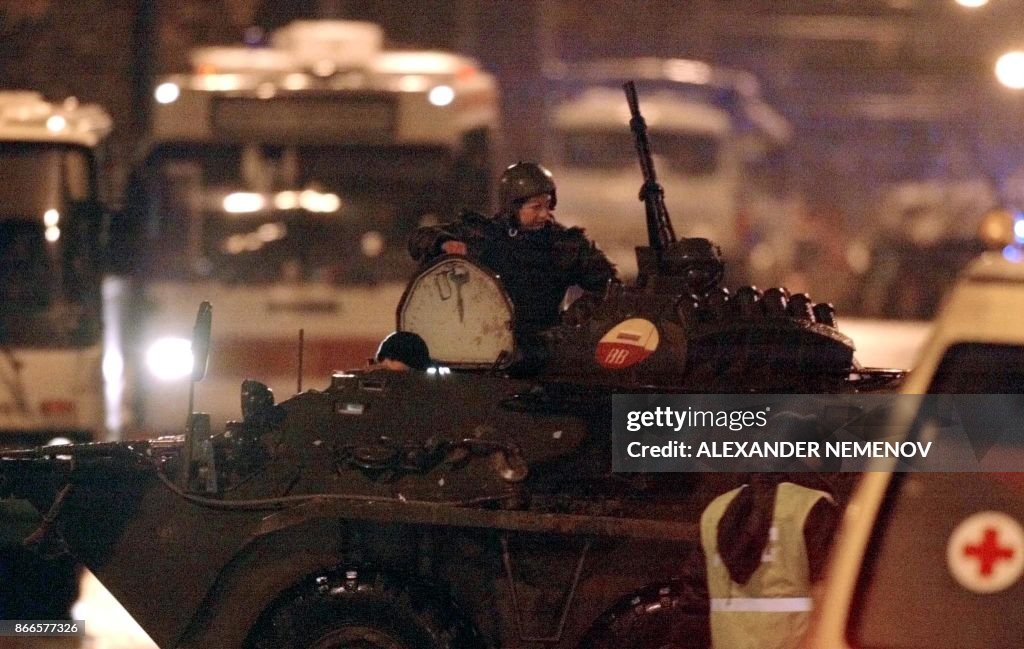
Before the assault, security forces sent an incapacitating substance through the ventilation system. The substance affected captors and hostages alike. All of the militants in the building were killed. Rescuers carried people out of the theatre, gave first aid and sent them to hospitals in ambulances and ordinary city buses. Through the bus windows, photographers saw passengers who had yet to regain consciousness.
2. Inside a bus
Provenance and sources for frame 2
Alexander Nemenov / AFP via Getty Images, ID 77506450, 26 October 2002. The larger file is a public watermarked Getty comp, not a licensed master. The clean feed preview comes from a Los Angeles Times publication with its own crop. The order of exposures across this collection is unknown. Displayed file: 1024 × 668 pixels. No free licence has been established for this file. Full image record in Russian.
gettyimages.comlatimes.comView image fileVideo later examined by the European Court of Human Rights shows city buses at 7:20 a.m.; by 8:03, they are lined up. One doctor said he dispatched two or three buses to hospitals. In each, he recalled, about twenty people were seated and another ten to twelve lay on the floor; some were already dead. Another doctor said some buses were accompanied by only one paramedic. These statements describe the evacuation as a whole. They cannot be tied with certainty to the particular buses in these photographs.
Doctors recognised signs of opioid poisoning and administered naloxone, but they had received no timely warning about the gas. The court also found that the mass evacuation was delayed: many hostages remained unconscious for more than an hour inside the building after the agent had been released. Outside, people were laid on their backs, increasing the risk of asphyxiation. They needed care at the theatre and on the journey; some died before reaching hospital or soon afterwards.
3. The yellow bus
Provenance and sources for frame 3
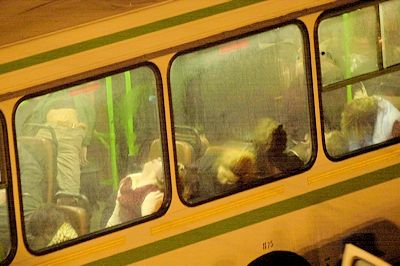
Dmitry Lovetsky / Associated Press, 26 October 2002. This small public copy comes via the University of Bristol, not an archival master; a later AP publication names the photographer. The order of exposures across this collection is unknown. Displayed file: 400 × 266 pixels. No free licence has been established for this file. Full image record in Russian.
chm.bris.ac.ukglobalnews.caView image fileRussian authorities did not disclose the exact substance used in the theatre, even to investigators. In 2012, British researchers published an analysis of clothing from two survivors and a urine sample from a third. They identified carfentanil and remifentanil, two potent opioids, on a shirt, and a carfentanil metabolite in the urine. The study established the presence of those substances, but could not determine their proportions or the complete composition of the aerosol.
According to official figures, 130 people died during the hostage-taking and its aftermath. On 20 December 2011, the European Court of Human Rights delivered its judgment in Finogenov and Others v. Russia. It did not find the decision to use force and gas itself to be a violation of the right to life. It did find violations in the inadequate preparation and conduct of the rescue operation, and in the ineffective investigation. Failures it identified included poor coordination, delayed evacuation and insufficient medical help.
4. Buses and an armoured vehicle
Provenance and sources for frame 4
Alexander Nemenov / AFP via Getty Images, ID 866577326, 26 October 2002. The file is a public watermarked Getty comp, not a licensed master. The order of exposures across this collection is unknown. Displayed file: 1024 × 649 pixels. No free licence has been established for this file. Full image record in Russian.
gettyimages.comView image file