W–048 · Early twentieth century; exact year unknown · Coney Island, New York, United States
The Girl at Coney Island
In May 1905, 51 people from the Bontoc region of the northern Philippines arrived at Coney Island. At Luna Park they built a village for visitors and performed before paying crowds. The attraction was presented as an introduction to the lives of people from a new American possession.
The showman Truman Hunt ran the venture. After supervising a Filipino exhibition at the St Louis World's Fair, he assembled his own group. According to the Coney Island Museum's research, participants were promised $15 a month and the proceeds from the goods they made. The details of those agreements are not fully known.
Hunt turned daily life into spectacle. He required the group to repeatedly build structures, staged ceremonies and organised 'dog feasts'. Newspapers repeated his stories and portrayed the Bontoc people as savages. In August, some of the group moved from Luna Park to Dreamland. Visitors watched adults and children behind a rail, as they watched the park's other attractions.
A Bain News Service glass negative shows a girl sitting among adults beside a wooden rail, with visitors standing behind her. The writing on the negative calls her a 'Filipino baby'. The Library of Congress holds it as LC-B2-807-6 but records neither the child's name nor a date of exposure. Online collections date the frame to 1905; the archival record establishes neither that year nor a connection between the girl and Hunt's group. Nor does it identify the people beside her or record what happened to her later.
1. The girl by the wooden rail
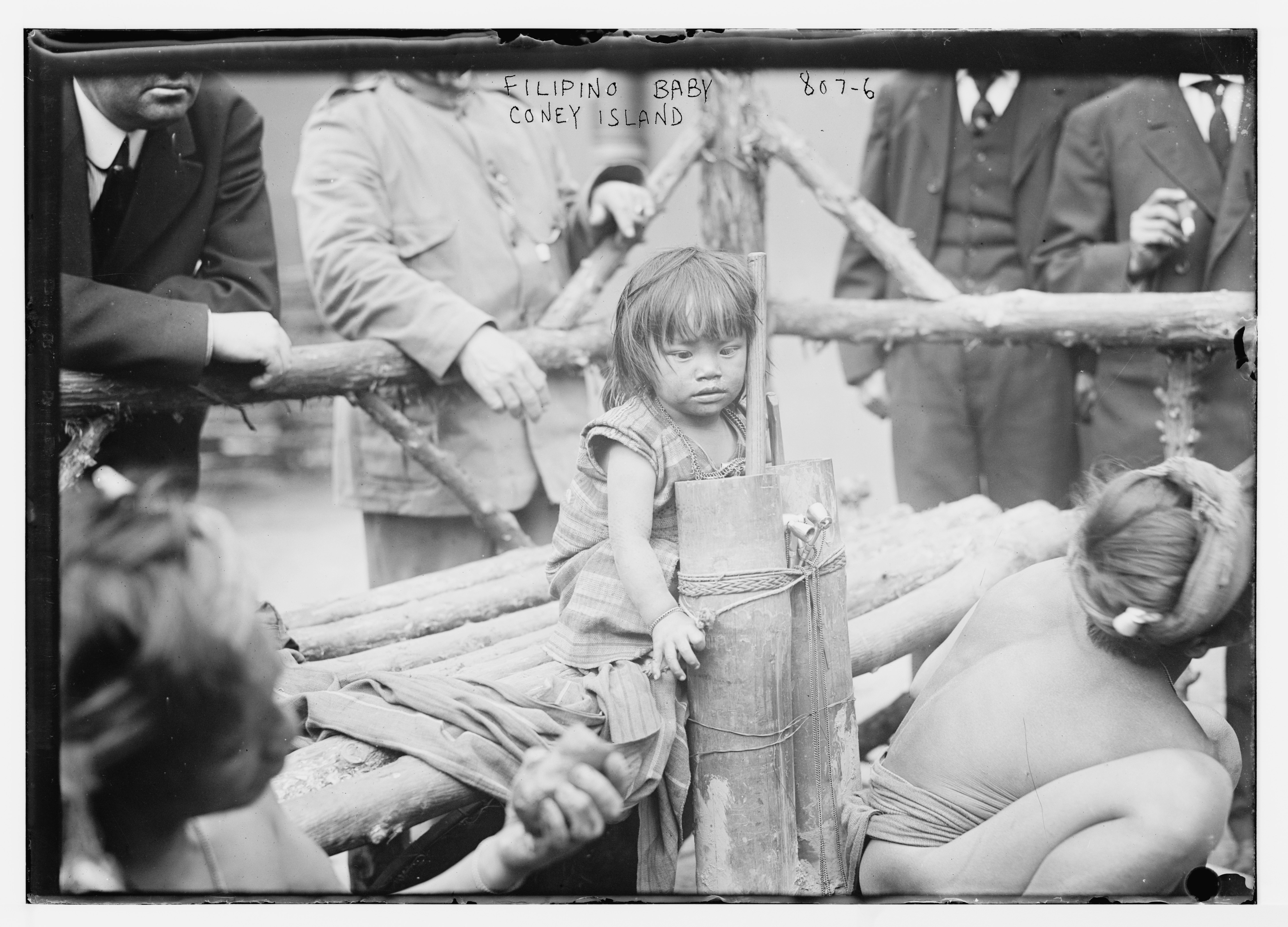
Provenance and sources for frame 1
File and rights
Original is an undated glass negative; no photographer is named. This 5,803 × 4,178 digital copy of the Library of Congress scan was obtained through Wikimedia Commons. The Library states that there are no known restrictions on publication. No generated detail or colourisation has been added.
The Coney Island Museum reports that participants complained of long hours, inadequate food and being forbidden to leave the site. Later they told authorities that wages had not been paid. Hunt was arrested in October 1906 and served eight months in jail. Five participants, including interpreter Julio Balinag and his wife Maria, remained in the United States to testify at his trial.