W–010 · Documentary photograph and sources
The Boy at the Cremation Ground
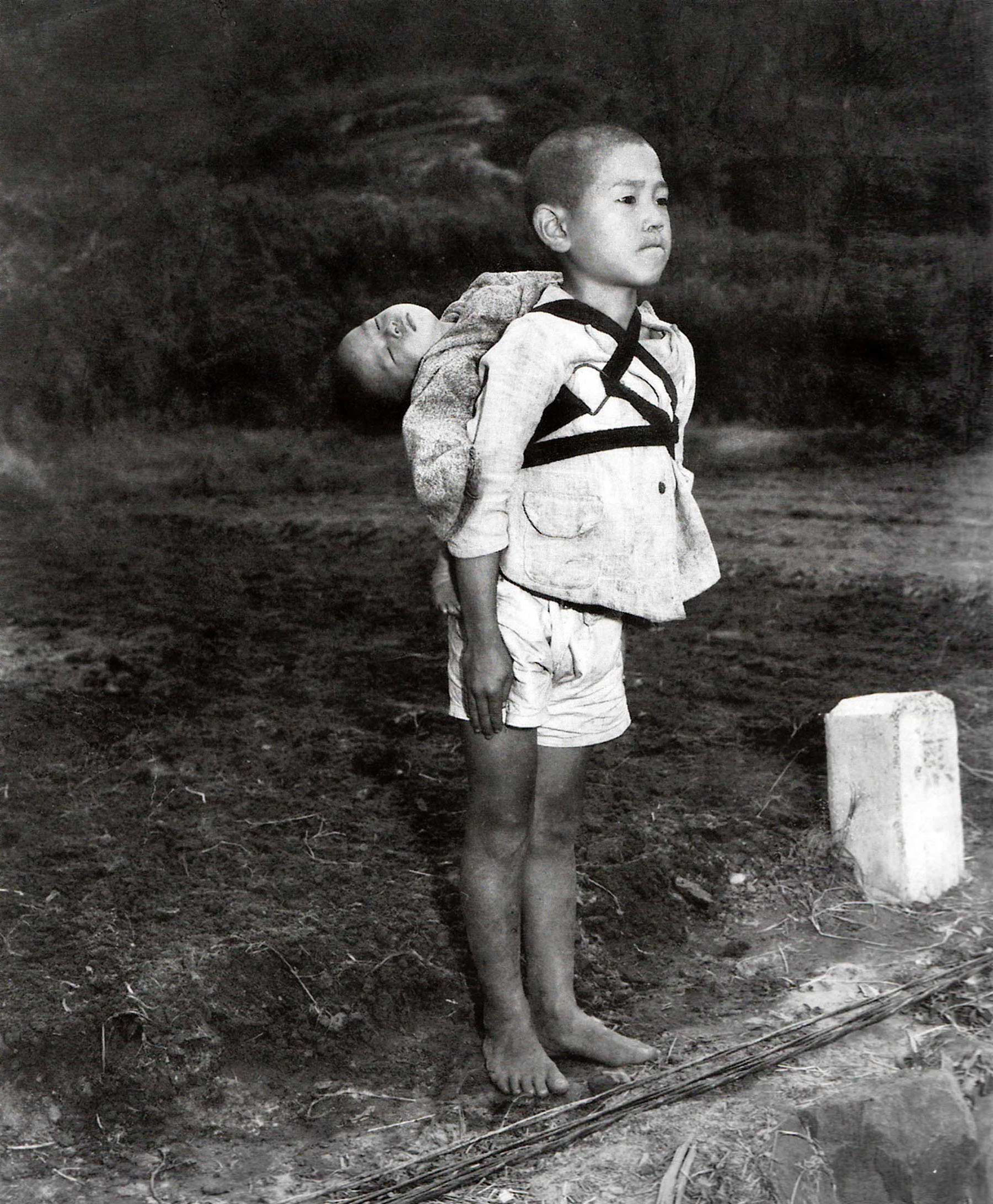
A boy stood at a cremation ground in Nagasaki with the body of a younger child on his back. Joe O’Donnell saw him in September 1945, after the atomic bombing of the city on 9 August. The American photographer was recording the devastated country on assignment for the US Marine Corps. In his account, he called the children brothers; no documentary record confirms their relationship.
1. At the cremation ground
Provenance and sources for frame 1
Joe O’Donnell photographed the scene during his US Marine Corps assignment in postwar Japan. The digital copy comes from the Atomic Photographers archive and follows its note on orientation. The source identifies the photograph as a US federal-government work in the public domain in the United States. Displayed file: 1801 × 2183 pixels. The source record discusses public-domain status; check which jurisdiction it covers. Full image record in Russian.
atomicphotographers.comen.hiroshima-nagasaki-museum.orghbsmuseum.jpcommons.wikimedia.orgView image fileAs O’Donnell remembered it, the boy waited silently for five or ten minutes. Then people in white masks took the body by its hands and feet and laid it in the fire. The boy did not move. He bit his lower lip so hard that it bled. When the flames began to die down, he turned and walked away.
O’Donnell wrote that he wanted to go to the child and comfort him, but feared breaking his composure. That explanation, like the details of the wait by the fire, comes from the photographer’s recollections. It is not recorded in a contemporary shooting log.
O’Donnell made some of his Japan photographs with his own camera. After returning home, he packed about three hundred negatives in a suitcase and did not show them for decades. In the 1980s, he returned to Japan and tried unsuccessfully to find the boy. He came back to the negatives themselves in the late 1980s. A Japanese edition of the series appeared in 1995; the English book Japan 1945 followed in 2005.
Over the decades, researchers have proposed different identities for the boy and different sites for the scene. None has gained general acceptance. The museum attribution gives Nagasaki and September 1945; the exact day and place, and both children’s names, remain unknown. The image alone cannot establish their ages or confirm that they were related.