W–033 · Documentary photograph and sources
Two Cases of Smallpox
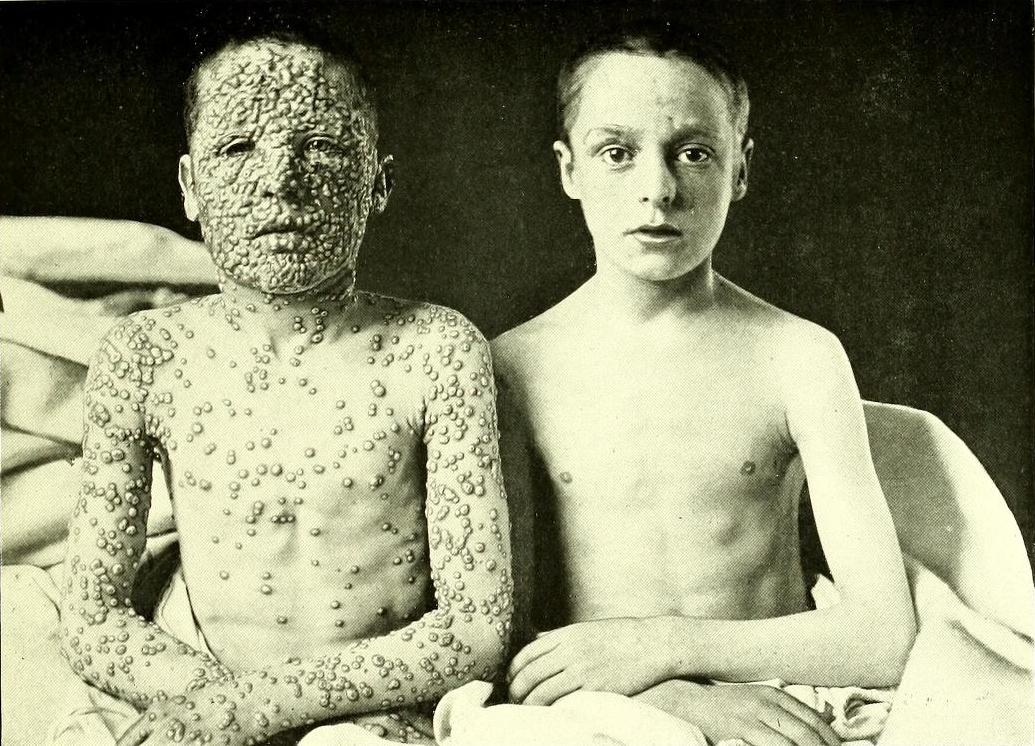
Two thirteen-year-old boys caught smallpox on the same day from the same source. One had been vaccinated as an infant; the other had not. The first developed only one or two lesions, which quickly scabbed over. The second was covered in smallpox pustules. That is how Allan Warner, a doctor at an isolation hospital in Leicester, England, described his patients.
1. Two cases of smallpox
Provenance and sources for frame 1
Physician Allan Warner of Leicester Isolation Hospital made this medical photograph. It first appeared in the 1906 Small-Pox issue of Atlas of Clinical Medicine, Surgery and Pathology; the exact day of exposure is not recorded. The atlas says the two thirteen-year-old boys were infected from the same source and that the boy on the right had been vaccinated in infancy. Displayed file: 1035 × 746 pixels. Full image record in Russian.
archive.orgwho.intcommons.wikimedia.orgView image fileWarner observed the illness, recorded its symptoms and photographed the boys. In his picture, the vaccinated boy sits on the right, the unvaccinated boy on the left. Edward Jenner had developed the first successful smallpox vaccine in 1796. More than a century later, the disease was still bringing children into hospital.
The photograph appeared in a medical atlas in 1906, in a section on how vaccination affected the course of smallpox. The vaccinated child had become infected too, but experienced a far milder illness. The caption does not say precisely when Warner made the exposure or what became of either boy.
The end of smallpox was still decades away. In 1967, the World Health Organization intensified its international campaign, vaccinating people and identifying and tracing new cases. The last known naturally acquired case was recorded in Somalia in 1977. Three years later, WHO declared smallpox eradicated.