W–016 · Documentary photograph and sources
Yakov Dzhugashvili: Captivity and Death
Yakov Dzhugashvili entered German captivity as an artillery officer and Nazi propaganda leaflets as Stalin’s son. A senior lieutenant commanding an artillery battery, he was captured on 16 July 1941 after his unit was surrounded near Vitebsk. Leaflets carrying his portrait soon began to fall over Soviet positions.
1. A prisoner at the field airstrip

Provenance and sources for frame 1
Displayed file: 3500 × 2635 pixels. The source record discusses public-domain status; check which jurisdiction it covers. Full image record in Russian.
szukajwarchiwach.gov.plView image fileThey urged Soviet troops to stop resisting, using the captive son of their leader to give the appeal force. The photograph itself says nothing about whether Yakov approved the message. It was taken in July before an interrogation; German servicemen stand beside him.
Svetlana Alliluyeva later described how the family received the news. She recalled her father telling her of her brother’s capture in August 1941. Stalin suspected Yakov’s wife, Yulia Meltzer, of involvement; she was arrested that autumn and released in spring 1943. By then, Alliluyeva wrote, Yakov’s conduct in captivity had convinced his father that he had not surrendered voluntarily.
2. A portrait with a German caption

Provenance and sources for frame 2
Displayed file: 1563 × 2501 pixels. The source record discusses public-domain status; check which jurisdiction it covers. Full image record in Russian.
commons.wikimedia.orgView image fileFrom 1941, Dzhugashvili was held at Oflag XIII D in Hammelburg. After an unsuccessful escape attempt in May 1942, he was transferred to Oflag X C in Lübeck. In 1943, he was moved to special camp A at Sachsenhausen, where prisoners of particular interest to the Nazi leadership were held.
Yakov died on 14 April 1943. German guards said he had entered the prohibited strip by the fence and been shot by a sentry. A photograph of his body beside the fence was included in the investigative file. Later American diplomatic correspondence described the event as an apparent attempt to escape over an electrified fence. These records do not establish whether Dzhugashvili was trying to flee, deliberately sought death or acted for another reason.
His captivity also gave rise to a story about an exchange for Friedrich Paulus: Stalin supposedly refused, saying he would not trade a soldier for a field marshal. Alliluyeva preserved a different account. She placed her conversation with her father in the winter of 1943–44: the Germans, he told her, had offered to exchange Yakov “for one of their own.” She recalled his answer as, “Am I to bargain with them? No. War is war.” Paulus is not named in her account. No primary document has been found offering an exchange specifically for him, and the soldier-and-field-marshal phrase is not verified as Stalin’s exact words.
3. A German propaganda leaflet
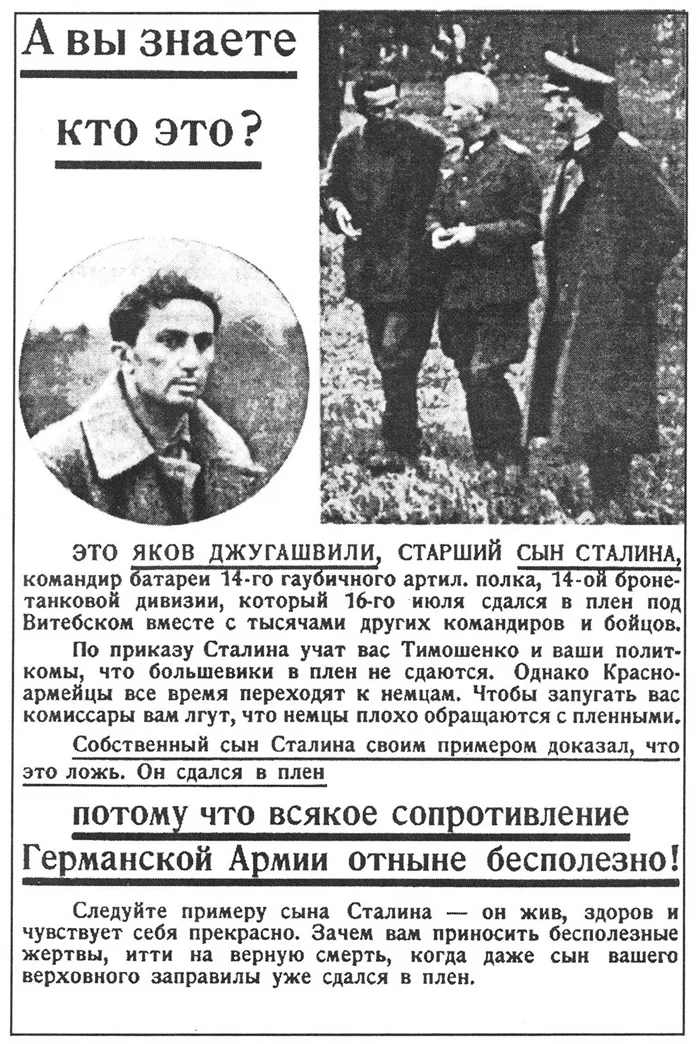
Provenance and sources for frame 3
Displayed file: 700 × 1044 pixels. Full image record in Russian.
commons.wikimedia.orgView image fileAfter the war, British and American diplomats discussed whether to give Stalin the German material concerning his son’s death. Their correspondence described microfilmed documents: a letter from Himmler to Ribbentrop, photographs and pages from the investigation. They decided not to hand over the originals and did not tell the Soviet side of the discovery.
In summer 1945, Alliluyeva wrote, Stalin told her Yakov had been shot by the Germans. He mentioned a condolence letter from a former prisoner whom he described as a Belgian officer. To his daughter, speaking about his son seemed difficult for him.
4. From the death investigation

Provenance and sources for frame 4
Displayed file: 755 × 420 pixels. Full image record in Russian.
bundesarchiv.dehistory.state.gov4tololo.ruView image file