W–011 · Documentary photograph and sources
The First of May at Dachau
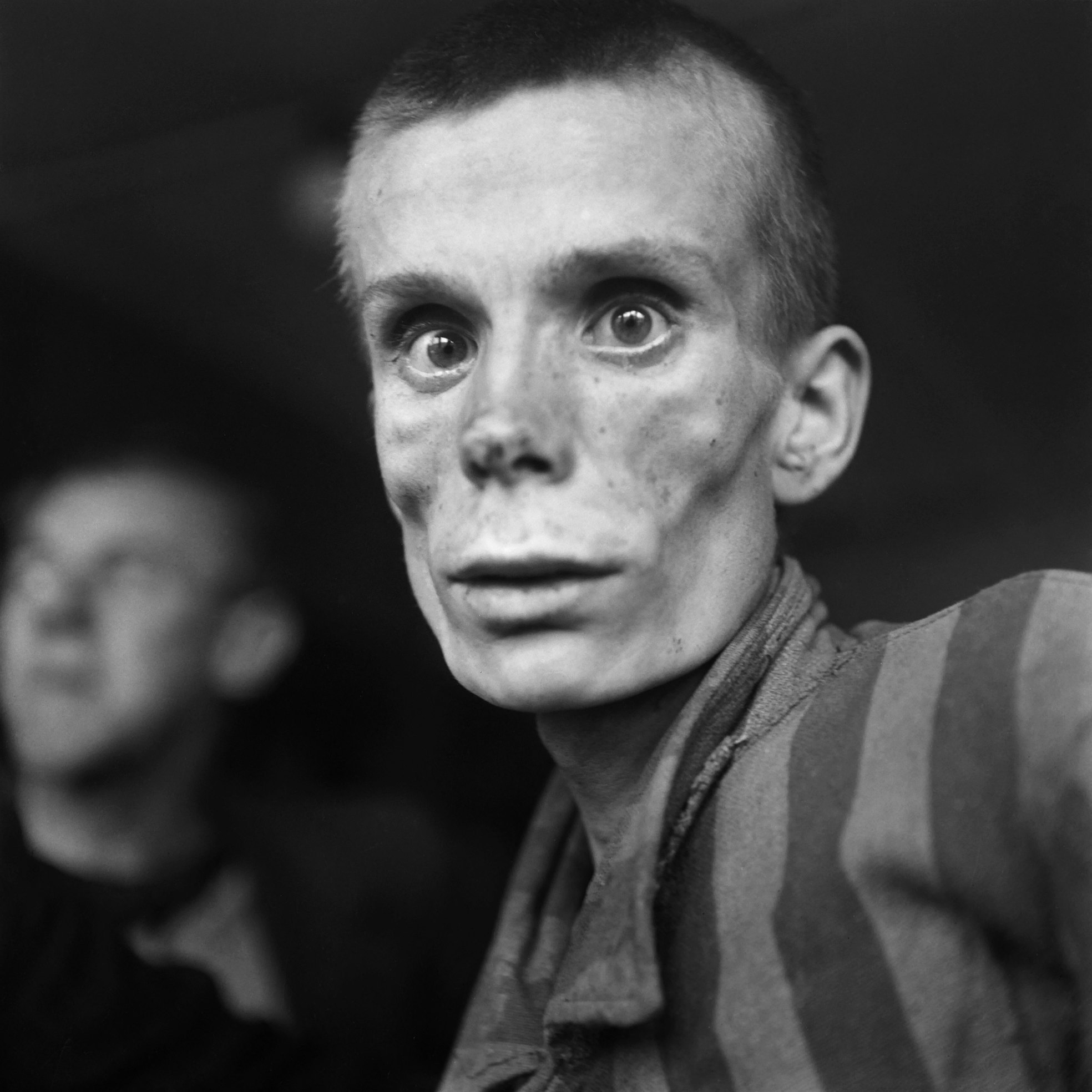
Liberation found thousands at Dachau too ill and exhausted for rescue to be complete. American troops entered the camp on 29 April 1945. Two days later, on 1 May, Eric Schwab photographed a young man whom an AFP caption describes as an eighteen-year-old “Russian Jew” suffering from dysentery. It gives neither his name nor his prisoner number.
1. A prisoner on 1 May
Provenance and sources for frame 1
Eric Schwab photographed this prisoner at Dachau on 1 May 1945. The AFP caption describes an unidentified eighteen-year-old Russian Jew with dysentery; that is the agency’s identification, not a name established independently. Rights: Agence France-Presse. The displayed digital copy comes from Süddeutsche Zeitung. Displayed file: 1968 × 1968 pixels. Full image record in Russian.
correspondent.afp.comfr.timesofisrael.comencyclopedia.ushmm.orgarmy.milView image fileIn the final months of the war, transports from other camps kept arriving at an already overcrowded Dachau. Hunger, filth and exhaustion helped epidemics spread. The United States Holocaust Memorial Museum’s Holocaust Encyclopedia specifically notes typhus; the caption to the young man’s portrait names dysentery.
On 26 April 1945, Dachau and its many subcamps held 67,665 registered prisoners. The Nazis forced at least 25,000 people from the camp system to march south or took them away in freight trains. Units of the US Seventh Army’s 42nd and 45th Infantry Divisions and 20th Armored Division took part in the liberation on 29 April. Some 30,000 weakened people remained in the main camp. Nearby, the soldiers found more than thirty railcars filled with prisoners’ bodies.
While photographing the camps, Schwab was searching for his mother, Elsbeth, deported in 1943. He had come to Germany with American journalist Meyer Levin. One of the first photographers for the newly founded Agence France-Presse, Schwab recorded Buchenwald, Leipzig-Thekla, Dachau and Theresienstadt. At Theresienstadt in May 1945, he found his mother alive.
The Dachau portrait is sometimes accompanied by a story that the prisoner died shortly after it was made. That account belongs to another Schwab photograph, of a Buchenwald prisoner with dysentery taken around 12 April 1945. What happened to the young man photographed at Dachau on 1 May remains unknown.